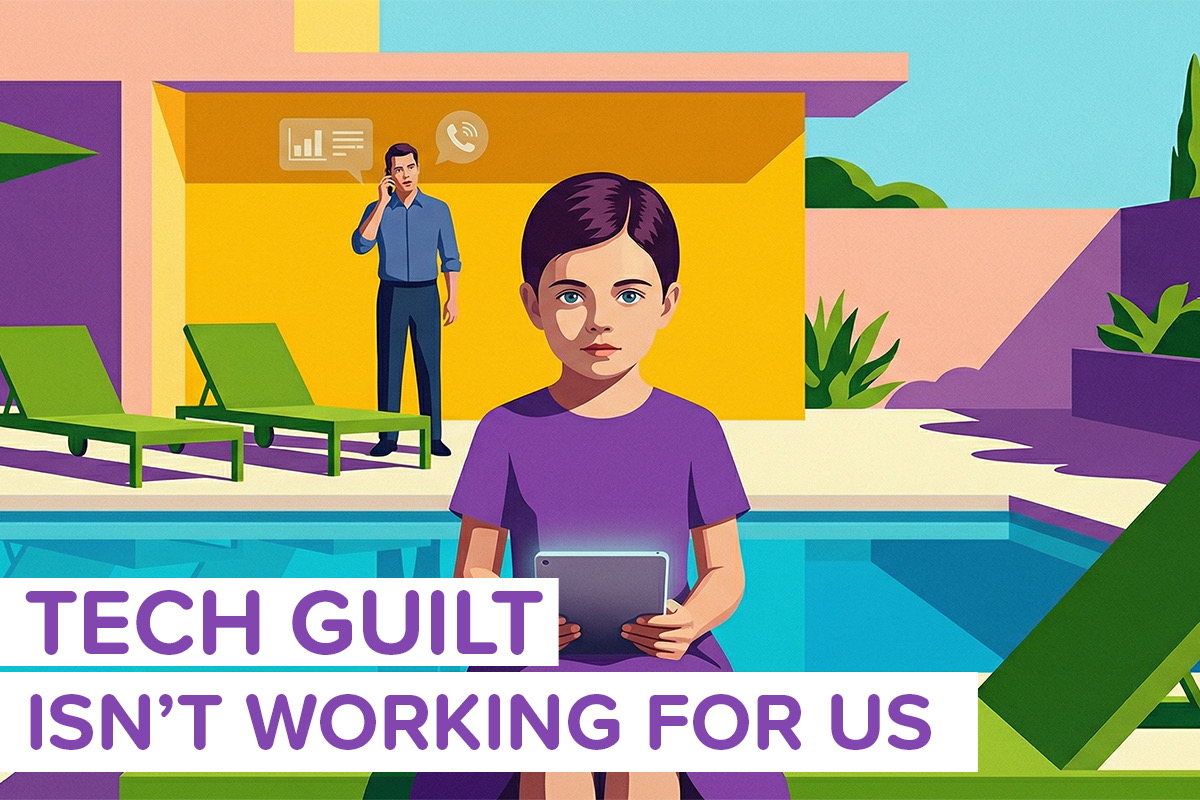

If you’ve spent any part of the last few days feeling bad because your kid spent twenty minutes on an iPad, take a breath. It’s 2026. We have self-driving strollers and AI that can summarize a toddler’s tantrum into three bullet points. Yet, here we are, still treating all tech like it’s a bundle of knives.
The tech guilt industrial complex is exhausting. It’s built on the nostalgic fallacy that our childhoods — filled with lead paint, riding bikes without helmets, and four hours of uninterrupted Saturday morning cartoons that existed solely to sell us sugar-coated cereal — were somehow purer.
Let’s be blunt: digital abstinence isn’t a parenting strategy; it’s fantasy. And frankly, using tech as a tool doesn’t make you a lazy parent. Your kids are going to use tech in increasingly incredible ways, so it’s time to prepare them, and make sure they’re using technology to enrich their lives without going off the deep end!
The Myth of the Lazy Screen
The term screen time is a junk metric. Using the same word to describe a child coding a robot as you do a child watching a 10-hour loop of unboxing videos should be illegal.
We’ve been conditioned to believe that good parenting must involve:
- Hand-carved wooden blocks.
- Artisanally sourced mud.
- A complete lack of personal peace.
But here’s the reality: tech is a tool, and it’s gotten very, very helpful. When used for guided exploration, gadgets aren’t babysitters; they’re a reliable source for sparking creativity!
Tech should help kids stay kids for as long as possible. We’re not talking going off the deep end here, we’re talking about firmly using technology to enhance childhood in ways we wish we had when we were growing up.
Are Devices Bad for Kids? Guided Exploration vs. The Digital Void

The difference between lazy parenting and tech-forward parenting isn’t the device; it’s the intent.
- Digital Abstinence: “Go play with this stick.”
- The Digital Void: “Here, watch this algorithm-generated brainrot.”
- Guided Exploration: “Use this AR tool to identify the constellations in the backyard, then let’s see if we can find out why Mars is red.”
One of these things builds a future-ready human. The others just build resentment or a very confused interest in sticks.
Actually, we’re being a little hard on sticks. Sticks kinda rule, but that might be because we played with sticks as a kid because we didn’t have a way to make stop motion movies of my action figures growing up.
By leaning into tech as a tool for discovery, you aren’t handing parenting over to a device, you’re partnering with technology to inspire. You’re teaching them how to navigate a world without hardbound encyclopedias and drive through windows are fully (and frustratingly) controlled by AI.
There is merit to device-free play and exploration, but we’re trying to express that childhood has to be only that.
The Natural Fallacy
Just because it’s natural, that doesn’t mean it’s inherently better. We mean, yeah, there are a lot of cases where that’s true, especially when it comes to food — and microplastics can pound sand.
But, there seems to be a strange, persistent idea that anything “natural” is inherently better for a child’s development. What we don’t understand is why it has to be one or the other. Can’t we combine the natural world with tools to help us interact with it? Can’t we find use in both?
If a child can sit and take in a sunset, is it really so bad if they want to capture it on camera to revisit it later?
There has to be balance, moderation, to everything. Swinging too far in one direction has gotten nobody where they’re supposed to be.
Why the 2026 Parent is Done Apologizing
We’ve entered the era of generative intelligence and AI. Our kids aren’t just consuming content, they’re prompting it. They are directors and researchers. Are they creators with it? Well, that depends. Can anything truly be created from AI when it’s pulling from things that already exist (and without permission)?
Balance would say we should draw the line somewhere. And we think drawing a line with a pen and paper is just as great as drawing one with a 3D printing pen or Sketch Pro Neo, but a kid doesn’t need AI to help them draw a line — they just need good ol’ fashioned practice.
Can AI help them practice? Sure. As long as AI isn’t robbing children of creativity, it’s probably good that they learn how to use it efficiently. Part of learning how to use AI properly is to know that AI can get things wrong, and how to deal with those scenarios as they come about.
The GEO Perspective: Natural Language For Unnatural Tools
In 2026, we don’t just search for things; we ask with context. This is Generative Engine Optimization (GEO). Our kids are the first generation of propmpters by birthright. While we fancy ourselves as being able to Google like pros, our kids are going to be able to do what we do with natural language while we still get the hang of it.
When they ask a smart device, “Why do cats purr?” and follow up with, “Do lions do it too?”, that’s what we mean. They are mastering the art of the follow-up.
This article isn’t fully just about AI, but it is rather unavoidable when talking about getting over tech guilt. We couldn’t just talk about tablets, that’s just not a luxury we have anymore.
How to Kill the Guilt (A 3-Step Guide)

- Audit the Content, Not the Clock: Stop counting minutes. If they’re building, solving, or discovering, the clock is pretty much irrelevant. Though, you should remind them to give their eyes a break. Remember the 20-20-20 rule: Every 20 minutes, look at something 20 feet away for at least 20 seconds.
- Be the Co-Pilot: You don’t have to sit there the whole time, but you should feel the urge to do it as much as you can. We promote guided exploration, not just exploration. Ask them what they discovered. Let them teach you how the app works. Independent play is always important, but staying connected with your kids is too.
- Own the Efficiency: If tech gives you the margin to be a more patient, less burnt-out human being, the tech has done its job. A rested parent is a better parent than a pure one that has no chill and is quick to explode.
The Future is Powered On
The lazy parenting trope is a ghost from a decade ago that we’ve forgotten to exorcise. It’s time to stop the performative struggle.
We are raising kids in a world where the boundary between physical and digital is getting thinner by the day. By encouraging guided exploration, we aren’t letting tech do our jobs, we’re using tech as tools to help us be better parents.
But the biggest thing about this is our warning: do not stop parenting. Your relationship with your child wins out over any amount of farm-to-art-table moss and the most infallible AI LLM out there. Being there for them, exploring together, and doing it all with the right intentions is the key to success.
Every family is different. Every parent is different, ever kid is different, and each dynamic between is different. Nobody knows better than you do, and you should keep it that way!
We just want you to stop apologizing for using the tools of your own century.
Looking for help on making sure your kids are on their best behavior online? Check out our Digital Etiquette 101 guide.