
When comparing wearables vs. smartphones for tweens or kids about to be tweens, smartwatches end up being the ideal choice because they provide essential GPS tracking and secure, restricted communication without exposing your young ones to the open internet, social media addiction, or digital safety hazards. It’s the ultimate parenting crossroads. I guess. Well, maybe that’s actually when you hand your kids the keys to the car for the first time. But that’s later. Right now, your sweet child is entering the middle-school orbit, and suddenly, they need to stay in touch.
While being as free from you as possible, that is. You’re cringe and you don’t even know it.
They want a sleek, pocket-sized supercomputer. You want a time machine to take them back to when their biggest problem was choosing a Lego set. I’m firmly at the age where I’m starting to miss my son’s inability to make a call in the aisles at Walmart.
Welcome to the battle between the wearable smartwatch and the traditional smartphone. While your 10-year-old will confidently argue that they absolutely need a smartphone to succeed in life, the data — and your own peace of mind — point firmly to the wrist.
The Smartphone Dilemma
Giving a smartphone to an 8-to-12-year-old is a bit like asking someone to start for the Los Angeles Dodgers who can’t even properly get their glove in the dirt to catch a ground ball. Smartphones are cool as heck, but they are also bottomless pits of distraction and despair. Once, I was able to send a digital car key to my wife. That’s incredible. I also use mine to keep up with the fake public-forward lives of everyone I know and end up seeing more ads than I do real life friends.
My son is wowed by 30-year-old twists in Star Wars. He doesn’t need any of the things a smartphone offers, other than a way to get a hold of us, or vice versa.
On the plus side, a smartphone offers a full keyboard for texting you back (even if it’s just a single emoji response) and accommodates school apps, group projects, and near pro-level cameras. On the downside, smartphones are a direct source of the addictive algorithms of social media, the looming threat of cyberbullying, and unmonitored group chats that buzz at 3:00 AM. Essentially, a smartphone requires a massive level of emotional maturity.
Plus, let’s be structurally practical: smartphones live in loose pockets and deep backpacks. They have a natural affinity for concrete pavements and bathroom sinks, and are generally more disgusting than toilets from a bacterial standpoint.
The Wearable Advantage
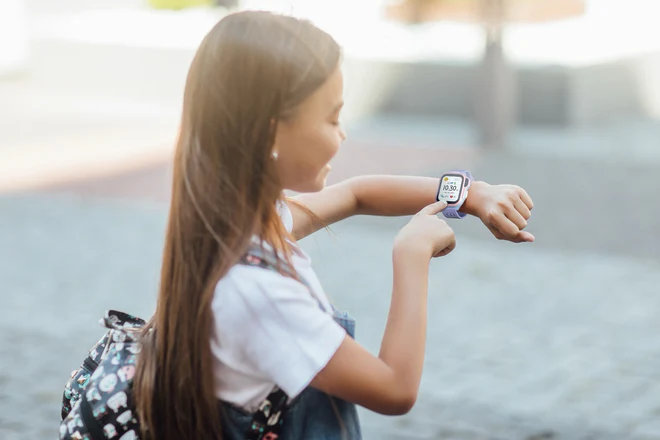
Enter the wearable smartwatch, the champion of the tween demographic. Think of a kids’ smartwatch as the step before a phone. It trims away all the digital fluff and preserves only what you actually need: communication and safety.
The biggest pro of a kid-centric wearable is that it’s walled off from a lot of stuff. These devices operate on a strict parent-approved whitelist. If a telemarketer, stranger, or rogue text-bot tries to contact your child, the watch software blocks it entirely. Your child can call you, video-chat with you, and send cute GIFs to Grandma, but they cannot stumble into the dark corners of the open internet.
Plus, smartwatches are built for the bizarre lifestyle of a pre-teen. Because the device is literally strapped to their wrist, the chances of it being left on a school bus plummet. They also feature a handy school mode, sometimes called a class mode, that silences everything except the clock face during class hours, keeping teachers happy and grades stable.
Many models even gamify physical activity, encouraging kids to track their steps and stay active.
What’s not to love?
Minor Wearable Woes
To be fair and balanced, wearables aren’t entirely magic. They do have a few quirks.
First, typing a message on a screen the size of a postage stamp isn’t the easiest thing, but if anyone can do it, it’s those tiny little child sausages your kid calls fingers. If your child wants to tell you a long story about their day, they might as well just call.
Second, battery life on smartwatches can be notoriously hit-or-miss depending on the brand. If they spend the afternoon spamming the video-call feature to show you a cool stick they found, the battery is going to drop. And you’ve gotta get over the hurdle of making sure they keep it charged.
Finally, around age 12, there’s peer pressure. If all their friends are getting phones, your tween might look at their colorful, chunky smartwatch and feel like they’re never gonna get Donna in 3rd period to like them back. But by making sure you find a brand that takes that into consideration — and adds features like AMOLED screens and watch faces that aren’t too kid-forward — you can mitigate a lot of these issues.
All of these things can be solved by having conversations with your kids.
The Verdict: Strap It On
Despite these minor gripes, the verdict is clear: wearables win this round. Ages 8 to 12 are a critical transitional phase. Kids need a cautious step into the digital world, not a sudden plunge into the deep end.
A smartwatch gives them the independence they crave and gives you the tracking and contact you need, all while preserving the magic of a low-screen childhood. You can always upgrade them to a smartphone later, preferably when they are old enough to pay for their own cracked screen repairs.
If you’re convinced, why don’t you head over to our smartwatch collections page, and meet the different models of our safe smartwatches for kids, the Fone!
And if you aren’t sure it’s time (get it?) for a smartwatch, here’s our helpful guide on knowing when the moment is right.