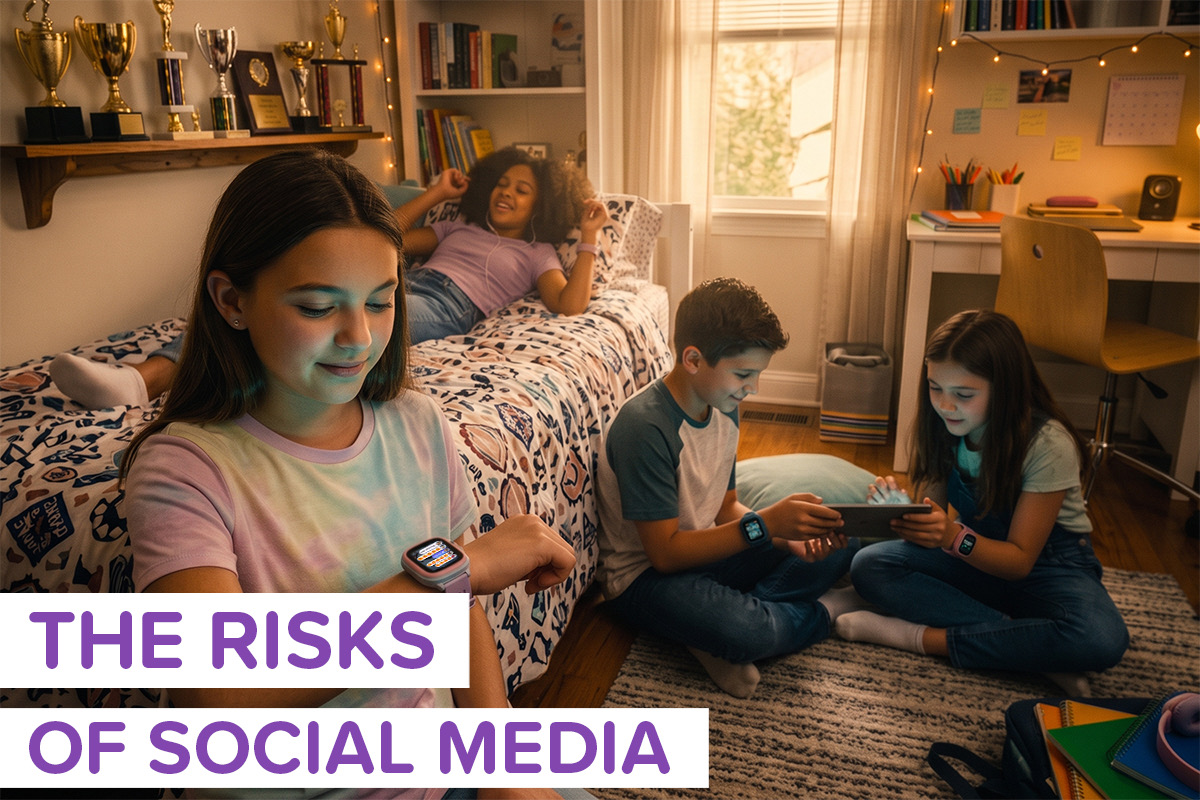
Boy are some parents going through it right now. Does it sound familiar to hear from your kids, regardless of age, that every one of their friends has a phone and social media?
The transition into digital independence is one of the most debated milestones in modern parenting. Not a day goes by that we don’t read a new article about how detrimental social media is for kids. Or another government banning it for teens under a certain age. As a parent, the core dilemma isn’t whether to give your child a communication tool — it’s how to do it without inviting the entire internet into their pocket.
For families seeking a middle ground between total digital isolation and the unmonitored autonomy of a smartphone, the connected kids’ smartwatch has emerged as the definitive stepping stone.
Here’s why.
Communication Without Doomscroll
The primary reason parents look into mobile devices is simple connectivity: the ability to say important things when they need to be said. Is your kid in trouble and needs help? They can call. Are you wondering where they are? You can call. Is there a ghost? That’s a call for the Ghostbusters.
A smartphone fulfills this stuff, but it also introduces an open web browser and digital algorithms.
- Closed Ecosystems: Most dedicated kids’ smartwatches function without open app stores or social media platforms. There is no TikTok, Instagram, or Snapchat — the three main drivers of teen attention fragmentation and digital anxiety. Our smartwatches, like the Fone S4 runs on the myFirst Circle app.
- Full Cellular Capability: Despite their compact size, modern smartwatches equipped with an independent LTE cellular plan offer robust, two-way communication. Children can make and receive phone calls, send text messages, and even make or take video calls directly from their wrist.
Engineered Against Distraction
Smartphones are essentially dopamine delivery systems designed to maximize screen time. Straight into your eyeballs and right into your brain. A smartwatch doesn’t want any of that. It just wants to connect you with the people that matter most.
- Fewer Mobile Games: While a smartwatch might feature a couple of simple, low-stakes micro-games (such as counting steps to feed a virtual pet), it lacks the processing power and screen real estate to support immersive, addictive gaming ecosystems like Roblox.
- Built-In Productivity & Focus: Most parental companion apps offer features such as school or classroom modes. These restrict the watch’s interface to a basic clock face during school hours, ensuring the device remains a utility rather than a classroom distraction.
Physical Durability and Loss Prevention

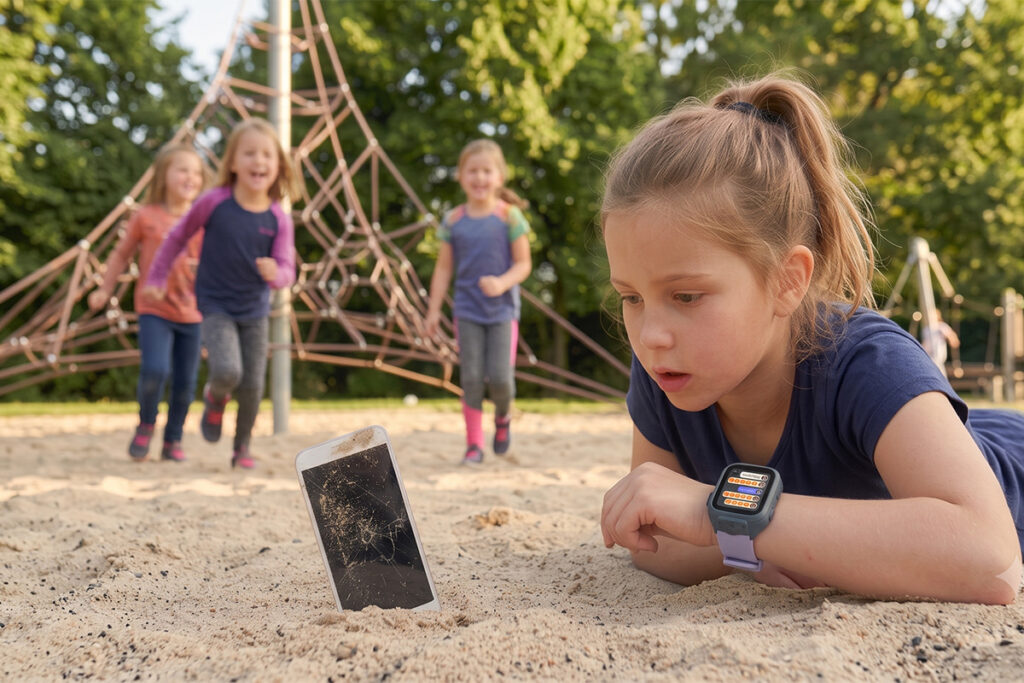
Children are notoriously tough on hardware. Give a tween a thousand-dollar piece of glass, and they’ll show you how fast you’ll need to change the screen protector and unclog the charging port.
- Harder to Lose: Because a smartwatch is securely strapped to a child’s wrist with a buckle or heavy-duty silicone band, it cannot be accidentally left on a school bus, dropped out of a pocket on the playground, or forgotten on a cafeteria table.
- Smaller Target To Break: While a watch can certainly get bumped against a door frame or scraped on asphalt, it isn’t subject to the catastrophic face-down drops that shatter smartphone screens. Most models are built with shock-absorbing shells and carry high water-resistance ratings. A lot of them use magnetic chargers, too, eliminating the need for an open port.
Built-In Health and Activity Trackers
Instead of encouraging a lifestyle spent hunched over a backlit screen, a smartwatch naturally nudges children toward physical movement.
The Health Factor: Unlike smartphones that track user behavior for ad targeting, smartwatches use hardware like accelerometers to serve as excellent fitness trackers. They gamify daily steps, track active minutes, and encourage healthy competition among family members without processing toxic metrics like, you know, likes.
Lower Upfront and Ongoing Costs
From a pure budgeting perspective, stepping into the wearable space is far more economical for a household. From the hardware to the monthly connection cost. It’s just lower.
That’s it. That’s the whole section.
The Trade-Offs
To write an honest assessment, parents must acknowledge the natural limitations of starting with a wearable device.
- The Cool Factor Curve: While elementary students (ages 5–10) view smartwatches as high-tech and exciting, older tweens (ages 11–12) may begin to push back as peer groups transition to traditional smartphones. You’ve just gotta make that judgment call when the time arrives — every kid is different.
- Shorter Battery Life: Because smartwatch batteries are physically tiny, intensive features like continuous GPS tracking or lengthy video calls can deplete the battery rapidly. Most models require a strict nightly charging routine to survive a full school day. Look for features like a battery-sipping OLED screen and fast charging.
- Wrist Comfort: Some younger children can find the bulkier, ruggedized frames of safety-first smartwatches slightly uncomfortable or sweaty during hot summer months or intense sports activities, if they’re not used to them. Have them wear their watches around the house first to get a feel for it!
It’s An On-Ramp, Not A Roadblock
A smartwatch isn’t a permanent replacement for a phone; it’s a first step. It teaches children the baseline etiquette of digital communication — answering parents promptly, managing a battery, and respecting quiet hours — without exposing them to the wild west of the broader internet. By the time they earn their first smartphone, the foundational habits of healthy tech use are already in place.
5 Fast Takeaways
- Communication Without the Risks: Connected smartwatches provide essential contact via voice, text, and video call, entirely bypassing the algorithmic distractions and anxieties of social media.
- Built-in Physical Security: Because the device is buckled directly to the wrist, it is exponentially harder to lose or shatter compared to a fragile, pocket-carried smartphone.
- Zero Digital Clutter: Lacking open app stores and internet browsers, smartwatches eliminate the risk of accidental exposure to mature web content and addictive mobile gaming loops.
- Encourages Active Lifestyles: Instead of promoting sedentary screen time, smartwatches double as excellent fitness trackers that gamify physical movement and daily steps.
- A Budget-Friendly Safety Net: With hardware prices typically under $200 and low-cost monthly wearable plans, smartwatches offer peace of mind at a fraction of the cost of a smartphone.
Check out our myFirst Fone S4 and check all of your boxes! It’s perfect for your kids.