There’s a version of childhood where kids learn to ride a bike with training wheels, learn to swim in the shallow end, and learn to handle money with a piggy bank before a debit card. Slow on-ramps, low stakes, room to fall over without anyone filming it.
Social media, while a bit more abstract than balancing on a bike, should be treated the same way. There are almost no (but we’ll get to some) upsides to letting your child use social media before they’re mature enough to handle it, but that doesn’t mean you shouldn’t help them prepare before they get on the seat.
Skipping guided exploration and giving a developing brain a global microphone, an infinite scroll, and a stranger’s opinion in their face harms their development and emotional fortitude. But this isn’t an anti-technology rant. Kids growing up without any digital fluency would be its own problem. The issue is sequencing — handing kids the full, adult-grade version of social media before they’ve had any practice with a smaller, safer one first.
What the Research Actually Says
The U.S. Surgeon General didn’t mince words about this. In a US Surgeon General’s 2023 advisory, Dr. Vivek Murthy noted that adolescent brain development starts around age 10 and continues into early adulthood — precisely the window when most kids are getting their first accounts. His office also pointed out that robust independent safety research on how social media affects young people simply hasn’t caught up to how widely they’re already using it.
And they’re using it a lot. Up to 95% of teens aged 13 to 17 report using a social media platform, with roughly two-thirds logging on daily and a third describing their use as almost constant. That’s not a hobby. That’s obsession. Addiction.
The advisory also flagged some specific effects worth sitting with: social media use has been linked to body image struggles, disrupted eating behavior, poor sleep quality, and increased social comparison and lower self-esteem — especially among adolescent girls. And it’s not just self-image on the line. Roughly 75% of teens say social platforms are only doing a fair to poor job of handling cyberbullying and online harassment — meaning most kids already know the safety net has holes in it, and they’re on the platforms anyway, because everyone else is too.
None of this means social media is secretly evil or that every app is quietly plotting against twelve-year-olds. Actually, it might. I’m not really sure, because it doesn’t seem like major social media platforms care beyond getting people (especially kids) back onto the platform, scrolling, and advertised to. Is that evil? Is that a plot against our young minds? Regardless, it’s not good.
At best, none of it is built with a developing brain in mind. At worst, it’s doing all those things on purpose. It was built for engagement, and a young, impressionable, still-forming sense of identity is remarkably easy to engage.
To Be Fair, It’s Not All Doom
Let’s steelman the thing for a second, because pretending social media has zero upside would be dishonest, and also the kind of claim a teenager would instantly see through and stop listening to.
It’s our job to educate them that the cons outweigh the pros when it comes to early unfettered access.
Social media, used well, gives kids a genuine sense of belonging to something bigger than their own living room. It’s how a shy kid finds other kids who like the same obscure hobby. It’s the sometimes the easiest way to organize plans. And for a kid whose grandparents, cousins, or best friend from their old town live somewhere else entirely, it can be the difference between staying close and slowly losing touch.
Community, coordination, and long-distance connection are real, valuable things — the goal isn’t to take those away; it’s to get kids there without the version of the internet designed to hold their attention hostage along the way.
The On-Ramp We’re Building
This is the actual argument: kids don’t need zero social interaction online. They need a smaller room first — one where the stakes are low, the people are known, and the habits get to form before the billionaire-enriching algorithm shows up.
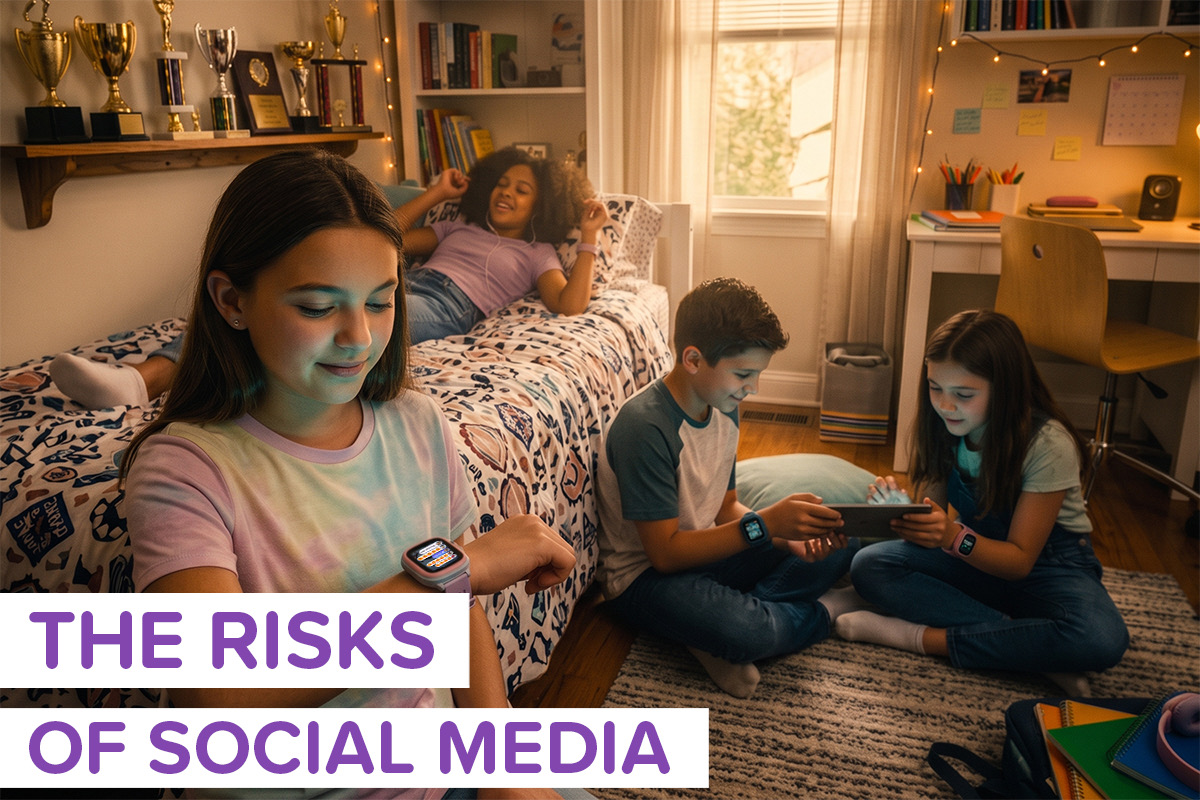
That’s the entire premise behind myFirst Circle. Instead of a public platform where anyone can find a child, myFirst Circle is built around a private circle of parent-approved contacts only — family and close friends, not followers. There’s no public feed to perform for, no stranger’s opinion to chase, no open DMs from accounts nobody’s ever met.
Parents get real oversight without hovering over every message: approving who’s allowed to talk to their kid, checking in through location sharing, and managing settings as the child grows. There’s a Circle Feed for sharing everyday moments with people who actually know the child — the digital equivalent of a fridge covered in drawings, not a public gallery. A Habit Trainer builds healthy routines through small, gamified wins instead of infinite scroll. And when your kid has one of our connected smartwatches, like our Watch S4, Care Call is the kind of quiet safety net most social platforms never bothered to build: if a child misses several calls in a row, it automatically checks in.
It’s not abstinence, it’s exploring the unknown together. Kids still get to chat, share, and coordinate plans — just with people their parents actually know, in a space designed for a developing kid instead of a platform designed to maximize screen time.
For Real, Though
Nobody hands a child the car keys and calls it learning to drive. They start with a bike, then a permit, then supervised practice, then finally the keys — because skill and judgment need time to catch up with access. Social media deserves the same sequencing, and right now, most kids don’t get one. They go from no accounts to the full public internet, mood, sleep, and self-esteem included, seemingly overnight.
The upside of connection is real — that’s worth protecting, not deleting. The fix isn’t less connection; it’s a version sized for the kid actually using it: private instead of public, supervised instead of wide open, and built to let a child practice being online before the whole internet finds out they’re on it.
Training wheels come off eventually. They’re just supposed to go on first.