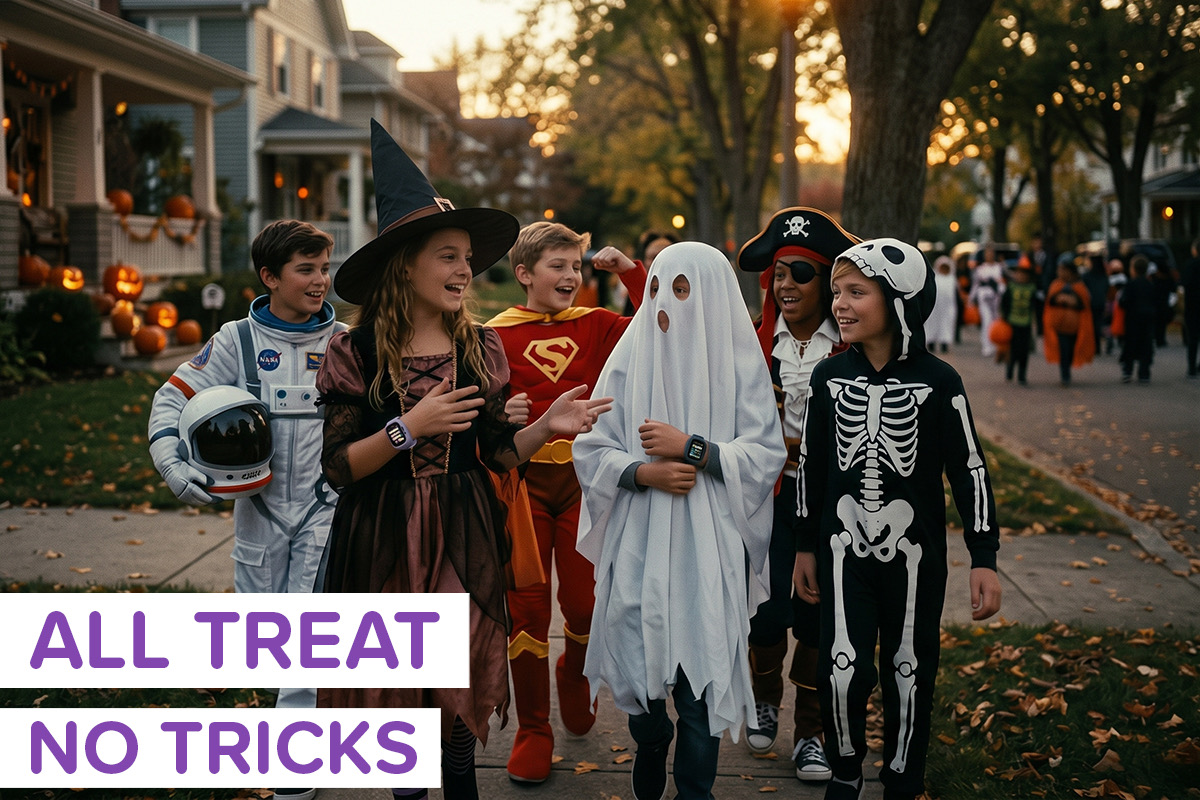
As a parent, and as my kids grow older, I still worry about their safety on Halloween. When they were younger, I was more afraid of them getting hit by cars or disappearing into the night than anything else. Now that they’re older, I’m more afraid of them getting lost if they’re off on their own with their friends or getting stuck somewhere, like a party, and finding themselves unable to leave, or the situation becoming dangerous.
Almost all of my fears are unfounded, and anecdotally I haven’t even run into anyone I know who has experienced anything like that with their own children.
Peace of mind goes a long way, yes, but I’ll start with this advice…
Stop Worrying, They’ll Be Fine
For real. Don’t become an overbearing parent who ruins the fun of the holiday. It’s already scary enough — and trusting your kids to make good decisions goes a long way. We talk a lot about how myFirst wants parents, kids, and families to explore together, and a big part of that is putting in the work before situations arise.
Talk to your kids! Keep the lines of communication open. And for the love of everything holy, don’t micromanage them into oblivion.
Is Halloween Actually Dangerous for Kids?
Not in the way movies and the evening news would have you believe. The stranger-with-a-poisoned-candy-bar story is mostly urban legend.
The real risks are far more boring: cars, dark sidewalks, tripping over a costume, and a kid wandering off while you’re distracted by a very good full-size candy bar. Safe Kids Worldwide reports that kids are more than twice as likely to be hit by a car on Halloween as on any other day of the year. That’s the one worth planning around, and the plan is mostly lights, sidewalks, and paying attention.
So the goal isn’t to scare yourself into bubble-wrapping the evening. It’s to handle the few things that matter and let everything else go.
Halloween Safety at a Glance
- 7 and under: Stay within eyesight, make them visible, and rehearse what to do if you get separated.
- 8 to 10: Give them a little rope, set boundaries, and use a GPS smartwatch as a safety net.
- 11 and up: Let them go with friends, agree on a plan, and make sure they have an easy way out of any situation.
- Every age: Light, visible, fed, and talked to.
Halloween Safety Tips for Kids 7 and Under
At this age, your job is simple: be the grown-up. You are the chaperone, the flashlight holder, and the designated carrier of everyone’s discarded mask. How much candy you get as payment varies from kid to kid.
- Make them glow. Glow sticks, light-up shoelaces, and reflective tape on costumes make small humans visible to drivers. Black cat costumes are adorable. They are also camouflage.
- Keep them within eyesight. Not somewhere on the street. Actual eyesight. Holding hands while crossing is non-negotiable, even if they cringe.
- Check the costume before you leave the house. Hems that drag, masks that block vision, and capes that catch on everything are trip hazards. Face paint beats a mask for visibility, even if it doesn’t look as cool. Do a test walk down a dark hallway — feel free to laugh later about them bumping into the wall, after you’ve solved the problem.
- Put your phone number on them. Write it on a wristband or the inside of a sleeve, or tuck a card in a pocket. Little kids forget their own name when they’re excited, let alone your number.
- The Separation Plan. Stay where you are and find a parent with kids or someone in a uniform. Practice it once before the night starts, in a calm voice, not in the middle of a crowded street.
- Start building toward independence. Let them walk up to the door and do the talking while you wait at the bottom of the driveway. It’s a small step, and it prepares them (and you) for when they’re ready for more slack.
Halloween Safety Tips for Kids 8 to 10
This is the age where kids start to sprint ahead, and honestly, let them. Saves your tired, old feet, plus a little freedom here builds the confidence you’ll want when they’re older.
- Let them run ahead, within limits. Agree on boundaries before you leave: which streets, which blocks, and where the meeting spot is. They go ahead, you stay in range, and everyone gets to feel like the main character.
- Use a GPS smartwatch for kids. A myFirst Fone smartwatch lets you see where they are without hovering over their shoulder. It’s the difference between knowing and constantly checking.
- Teach them how to use it before they need it. Show them how to call or text you from the watch, and make clear it’s there for when they need help, not for sending you pics every thirty seconds.
- Set the buddy rule. Nobody walks alone. Kids go in pairs or groups, and nobody splits off.
- Set the house rules. They go to the door, say the line, take the candy, and leave. They don’t go inside, and they don’t get in anyone’s car, even if the person offering is described as nice.
- Keep the candy rule simple. Nothing gets eaten until a parent has looked through it. This has nothing to do with tampering and everything to do with allergies, choking hazards, and unwrapped items that have been through a pocket. Gross.
Halloween Safety Tips for Kids 11 and Up
At this point, the hardest part is you. They’re ready for independence, and the best thing you can do is set them up well and then actually let go.
- Let them go with their friends. Yes, without you. Agree on the route or general area, a check-in time, and a time to be home. Then say goodbye and resist the urge to “casually” drive by.
- Keep the safety net. A GPS smartwatch like the myFirst Fone gives older kids a way to reach you and lets you find them if plans change. For this age group, the pitch is simple: it’s a lot less embarrassing than you showing up.
- Give them space to make decisions. If they decide to skip a street, change plans, or head home early, that’s good judgment in action. Let it happen.
- Set up a no-questions-asked pickup. This is the most important one on the list. Tell them that if they’re ever somewhere that feels off, like a party that got out of hand, they can text or call you and you’ll pick them up. No interrogation, no punishment, and the conversation can wait until tomorrow.
- Agree on a code word. A simple word or emoji they can text that means “come get me now” without drawing attention. It gives them an exit without making them look like the one who ruined the party.
- Talk about parties ahead of time. Who’s hosting, who’ll be there, and how they’re getting home. You’re not interrogating them; you’re just planning like the two of you are on the same team.
- Make sure everyone’s charged. Phones, watches, flashlights. A dead battery is the most common way a good safety plan quietly falls apart.
Halloween Safety Tips for Every Age
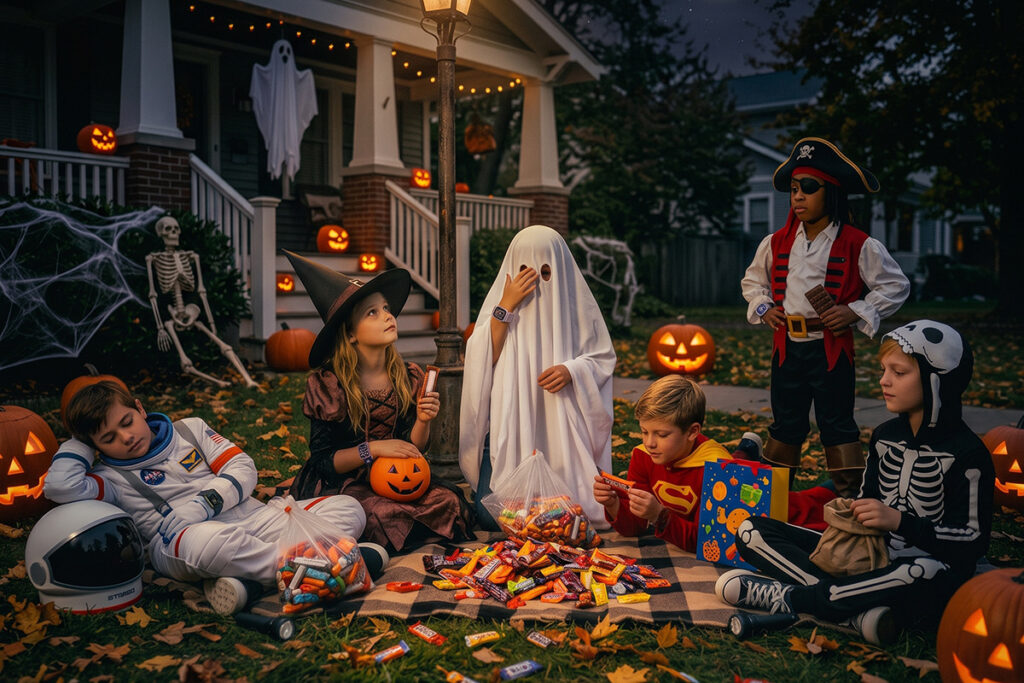
Some things apply whether your kid is a toddler in a pumpkin suit or a teenager in a very ambitious group costume.
- Feed them first. A real dinner before trick-or-treating means fewer sugar-fueled decisions and fewer tummy aches.
- Stick to lit houses and sidewalks. If the porch light is off, that house isn’t participating. Walk on sidewalks when they exist, and face traffic when they don’t.
- Look both ways, then look again. Drivers are distracted on Halloween, and kids are distracted by candy. Nobody’s at their best. Cross at corners and crosswalks, never between parked cars.
- Watch for food allergies. Check labels, and consider keeping safe swaps in your bag. Houses with a teal pumpkin out front are offering non-food treats for kids with allergies.
- Choose flame-resistant costumes. Check the label, and watch for candles and jack-o’-lanterns.
- Carry a flashlight or three. Your phone’s flashlight counts, but a real one is better, and kids love holding one.
- Talk before and after. Ask what they’re excited about and what worries them. After the night, ask what went well. This is the part that actually builds good judgment.
Frequently Asked Questions
What age can kids trick-or-treat without parents?
There’s no official age, and every kid is different. Many families start letting kids go with a group of friends around the start of middle school, once they’ve shown they can follow a plan, stay with the group, and reach out if something changes. Start with a short, well-defined route near home.
Do I really need to check my kid’s Halloween candy?
It’s still worth a quick look, mostly for allergens, choking hazards for little ones, and anything unwrapped or open. But if your kid is older and has no allergies, you’re doing it more for you than them. Widespread candy tampering is a myth.
What is the best way to track my kid on Halloween?
For kids who are ready for some independence, a GPS smartwatch lets you see their location without constant texting. The myFirst Fone is built for kids, with GPS location, calling, and texting, so they can reach you and you can find them. Check the myFirst Fone page for current features.
How do I make my kid visible at night?
Glow sticks, reflective tape, light-up accessories, light-colored costumes, and a flashlight all help. Avoid masks that block vision.
How can I talk to my teen about Halloween safety without being annoying?
Keep it short, make it about a plan rather than a lecture, and offer an easy way out, like a no-questions-asked pickup or a code word. Teens are far more likely to use a safety net that doesn’t come with a speech attached.
Have The Best Halloween
Halloween is one of the best nights of the year, and most of what makes it safe comes down to common sense and a little preparation. Light them up, talk to them, give them more room as they’ve earned it, and keep a way to reach them. Then go enjoy a night where the biggest threat is running out of the good candy.
Happy Halloween.