Somewhere between ages 5 and 12, every kid becomes an opinionated artist. It happens so often it’s almost stereotypical, but they will inform you, unprompted, that the sun is purple, that dogs have five legs if they’re running fast enough (or if their only reference is AI), and that your attempt to help with their drawing has ruined it beyond repair.
This is normal.
This is also, according to approximately every child development expert on record, an excellent sign.
Art gets filed in the same mental drawer as glitter and juice boxes — fun, messy, optional. But for kids in this age range, drawing and doodling aren’t just a way to kill twenty minutes before dinner. They’re quietly doing a lot of the heavy lifting that other subjects, like math and writing, get credit for.
The Boring-Sounding Reasons Art Matters
- Fine motor skills get a real workout. Holding a marker, controlling pressure, tracing a line without it wobbling into an entirely different shape — these are the same muscles and hand-eye coordination kids need for handwriting, using scissors, and eventually not spilling every liquid they’re given.
Drawing is basically physical therapy that a five-year-old will do voluntarily, which is a rare and precious thing. - It teaches problem-solving without anyone announcing that’s what’s happening. How do you make a horse look like a horse and not a very emaciated dog? How do you fit a whole castle onto one page (aren’t they huge?)? Every drawing is a small design problem, and kids solve dozens of them without ever feeling like they’re learning.
By a certain age, kids are conditioned to say that school sucks, and by extension, learning. They hear it everywhere — from peers, from siblings, in media that likes to take broad strokes to being a kid without any nuance.
So the more we can trick them into doing learning without calling it that, the better. Like hiding veggies inside other food, like a delicious Trojan Horse. - It builds focus and patience. Sustained attention is a skill, not a personality trait, and it has to be practiced somewhere. A kid hunched over a drawing for twenty straight minutes is quietly building the same mental muscle they’ll need for reading a chapter book or sitting through a math lesson.
- It gives big feelings somewhere to go. Kids in this age range are experiencing enormous emotions with a comparatively small vocabulary for describing them. Art gives feelings a place to land that isn’t the living room floor or a well-place shove to a sibling.
- It builds actual confidence, not just participation-trophy confidence. Finishing something you made — start to end, blank page to full picture — is one of the earliest ways kids learn that effort produces results. That’s a life lesson disguised as a stick-figure family portrait.
None of this requires art class, an easel, or a beret. It requires a kid, something to draw with, and enough runway before boredom sets in.
The Part Where Most Kids Quit
Here’s the catch nobody puts on the inspirational poster: kids are their own harshest critics, and they’re not shy about it. The divide between what a kid pictures in their head and what actually lands on paper is often where the whole art phase quietly dies. One smudged line, one wonky ear, one horse that looks suspiciously like a dog, and the marker gets thrown down along with all future artistic ambition.
This is less about talent and more about tools. Paper is unforgiving. Mistakes are permanent, visible, and — in the eyes of a very literal child — proof that they’re bad at drawing. What actually keeps kids in the game is lowering the cost of trying again.
Enter: A Drawing Board That Glows
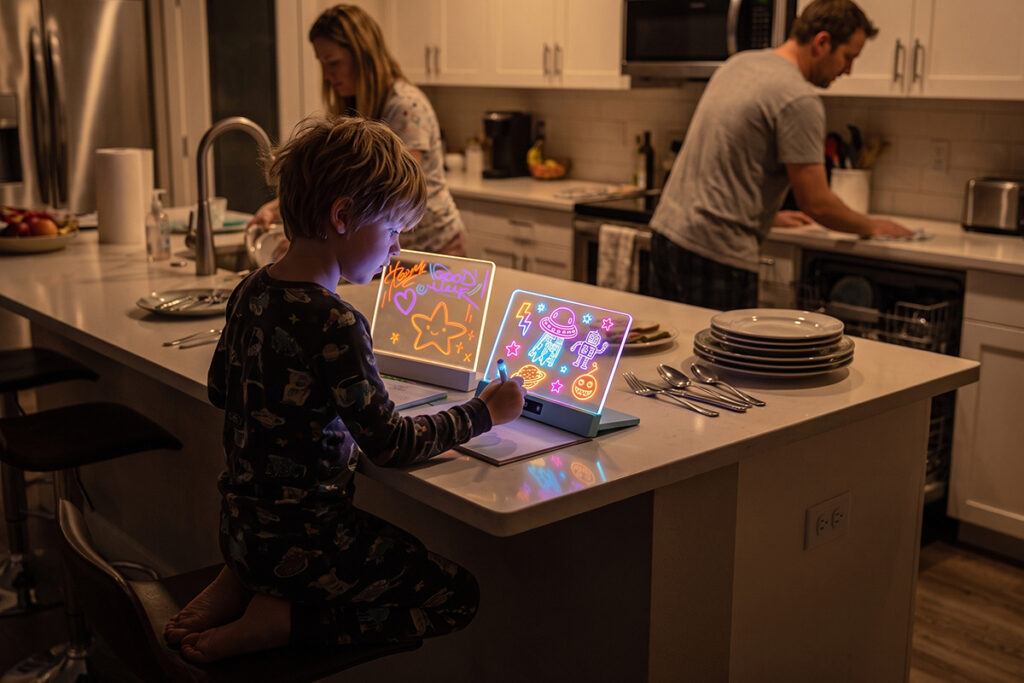
This is the void the myFirst Sketch Clear was built to fill, and it does it with the two things that matter most to a kid: instant payoff, and zero consequences for messing up.
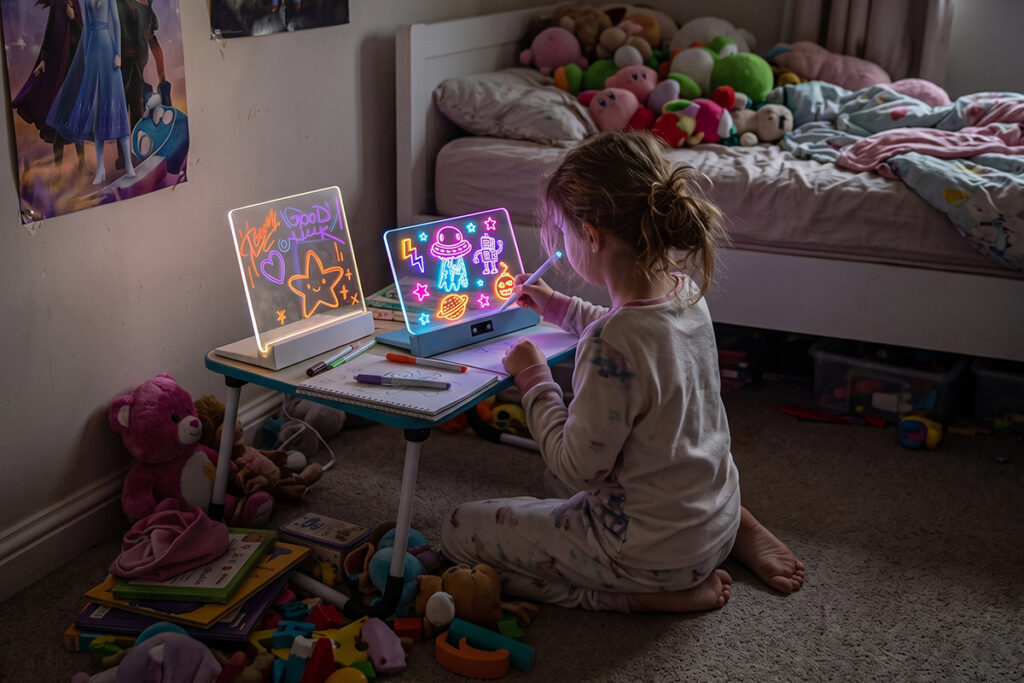
It’s a light-up drawing board that uses fluorescent markers and edge-lit LEDs, so a doodled star doesn’t just sit there looking like a star drawn in ballpoint pen — it actually glows, like it wandered in from outer space.
And when the horse inevitably ends up looking like that emaciated dog? One wipe, blank panel, no mess, no evidence, no meltdown. The board removes the exact failure point that makes kids quit and replaces it with an infinite number of do-overs. That alone does more for a kid’s persistence than any pep talk because now they don’t have to sit and stare at the mistake while you say it.
Plus, repetition builds muscle and skill.
It’s also not limited to blank-page free draws, for kids who want a starting point. Slide a photo or printout underneath the clear panel and trace over it — a template nobody else has to know about. Hold it up to a window and turn the view outside into a spaceship launchpad or a racetrack. Lay a magazine page underneath and add wings, crowns, or rocket boosters without touching the original.
And because a masterpiece that lives in a drawer might as well not exist, the boards are built to be displayed. The Sketch Clear 16 has a built-in stand for the desk or shelf; the Sketch Clear 11 sits on its own LED base and travels easily. Either way, when the room lights go off, the art stays glowing, which is a much better fate than getting crumpled into a backpack.
The Actual Point
Kids don’t need to become the next great painter. They need chances to focus, solve small problems, work through frustration, and feel proud of something they made with their own hands — repeatedly, without a permanent record. Give them a tool that makes trying again easy and finishing something look genuinely cool, and the rest will fall in line.
The crayons still have their place. But a board that turns a doodle into something glowing enough to display? That’s the kind of thing that keeps a kid drawing past the point where they’d normally throw down the marker and declare themselves the worst at art forever.